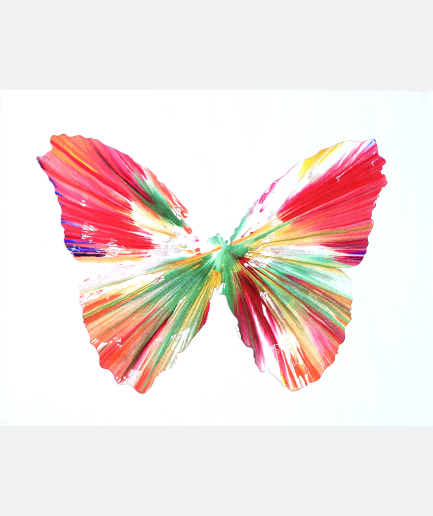
Damien Hirst (b. 1965, Bristol, England) is an English conceptual artist and entrepreneur renowned for his provocative works that challenge the boundaries between art, mortality, and wealth. Hirst studied Fine Art at Goldsmiths College from 1986 to 1989, where his early exploration of art as a conceptual medium laid the foundation for his career. His breakthrough moment came in 1988, when he curated ‘Freeze’, a pivotal exhibition that featured his first spot paintings and set the stage for his rise to prominence in the art world.
Hirst’s thematic focus revolves around death, rebirth, immortality, and the beauty of life’s fragility. Drawing influence from artists like Marcel Duchamp, he uses ready-made objects to provoke questions about the very nature of art. Hirst’s most famous works emerged from his ‘Natural History’ series, which began in 1991 and remains his most prominent. The series, best known for its shark preserved in formaldehyde, The Physical Impossibility of Death in the Mind of Someone Living, became an iconic statement on the fragility and finality of life. This piece, which features a 14-foot tiger shark in a tank of formaldehyde, became a defining symbol of 1990s British art and was displayed at the Saatchi Gallery.
In addition to his work with animals, Hirst explored other artistic techniques, such as spin paintings, which were created using machines that spun paint onto canvases, resulting in colorful, circular forms. These works were marked by vibrant hues and unique patterns, further cementing Hirst’s reputation as a boundary-pushing artist.
Hirst also explored the relationship between art, mortality, and wealth with ‘For the Love of God’ (2007), a platinum sculpture of a human skull encrusted with 8,601 diamonds. This extravagant work sold for a record price, reinforcing the intersection of art and commerce in his practice.
Throughout his career, Hirst has held over 80 solo exhibitions worldwide. His contribution to contemporary art is unparalleled, with his works housed in renowned museums such as the Tate Modern and the Museum of Modern Art in New York. Living and working between London, Gloucestershire, and Devon, he continues to create works that both intrigue and challenge the perceptions of art and life.
Hirst has also ventured into printmaking, experimenting with woodcuts, a technique where an image is carved into a woodblock and then inked and printed onto paper. These works, though lesser known compared to his spot paintings, reflect Hirst’s recurring themes, including his fascination with life, death, and nature. Collectors and enthusiasts value these woodcuts for their craftsmanship and the unique texture they bring to his oeuvre.
In addition to woodcuts, Hirst has created etchings, a traditional printmaking method where images are incised into a metal plate and then inked to create prints on paper. Hirst’s etchings often explore themes of mortality, pharmaceuticals, and religious iconography, closely mirroring his broader artistic concerns. Though not as widely recognized as his spot paintings, these etchings contribute to his diverse approach to art, offering collectors a more intimate glimpse into his conceptual approach to life and death.
Hirst’s screenprints—a method of transferring ink through a mesh screen—have also become an important part of his artistic portfolio. These prints, often featuring his signature motifs such as butterflies, skulls, pharmaceuticals, and spot patterns, are known for their bold imagery and striking visual impact. Hirst’s screenprints continue his exploration of repeated patterns and iconic imagery, allowing for a different means of engaging with his themes of mortality and transformation.