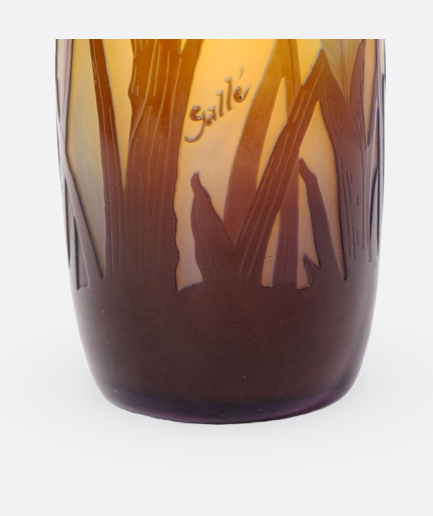
Émile Gallé (French, May 4, 1846 – September 23, 1904) was a renowned glass artist, ceramist, and designer, widely regarded as one of the most influential glassmakers of the 19th century. A leading figure of the Art Nouveau movement, Gallé was born in Nancy, France, into a family deeply rooted in the faience and furniture manufacturing industry. From a young age, he was exposed to the techniques of tin-glazed pottery, which laid the foundation for his future artistic endeavors.
In his youth, Gallé pursued studies in drawing, philosophy, and botany—disciplines that would later heavily influence his work. He later acquired practical experience in glassmaking at Meisenthal. Upon returning to Nancy, he joined his father’s business and in 1873 established his own glass workshop, where he expanded his craft to include fine ceramics, jewelry, and furniture. Just a year later, in 1874, he assumed control of his father’s factory. Initially, his designs featured clear glass adorned with enamel decorations, but he soon began experimenting with opaque glass and multi-colored plant motifs created through etching.
Gallé’s talents gained international attention at the 1878 Paris Exhibition, where his intricate glass creations were met with great acclaim. This marked the beginning of his prominence as a glass artist. At the 1889 Paris Exhibition, his work became emblematic of the Art Nouveau style, thanks to his inventive use of techniques such as embedding air bubbles and incorporating metallic foils into the glass. Capitalizing on his success, Gallé established a factory that allowed for the mass production of his artistic glassware, significantly influencing the broader glass industry.
In 1901, Gallé co-founded the École de Nancy—a formal alliance of Art Nouveau artists and craftsmen—alongside figures such as Louis Majorelle and Eugène Vallin. His artistry, deeply inspired by nature, was reflected in his use of various methods such as enamel painting, wheel carving, stratification, and acid etching. He mastered the creation of enameled glass and refined the techniques for cutting and incising flashed glass, enhancing their beauty through vivid colors and the natural transparency of the medium. His diverse portfolio included vases and lamps, some of which were produced in more affordable versions known as “industrial Gallé.”
Although Émile Gallé passed away in 1904 in Nancy, his legacy endured. His widow managed the business until 1914, when World War I disrupted operations. Gallé’s factory continued producing primarily acid-etched glass pieces until 1936, the year it permanently closed. His writings on art were published posthumously in 1908 under the title Écrits pour l’art, further cementing his intellectual and artistic contributions to the Art Nouveau era.
-
Sold Out

![Floral Vase]()
Floral Vase